
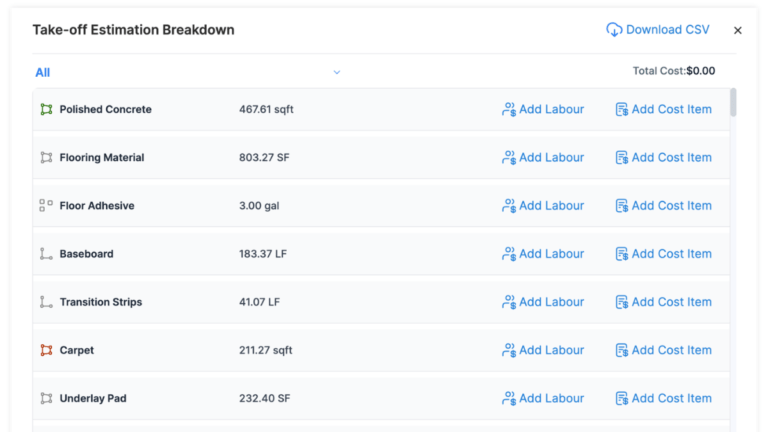

A construction estimate turns measured quantities into a structured project cost. It is not just a list of numbers. It is a financial model of how the job will be built.
For a full overview of how estimating fits into the construction workflow, see: Construction Estimating Explained: From Takeoff to Final Price
Step 1: Start With Accurate Quantities
Every estimate begins with a takeoff. If the quantities are wrong, pricing will be wrong no matter how detailed the math is. That’s why estimating always depends on accurate measurement first.
If you need a refresher on how quantities are created, see: How to Do a Construction Takeoff (Step-by-Step Guide)
Step 2: Apply Material Costs
The first pricing layer is materials. Contractors apply unit costs to the measured quantities.
Material pricing may be based on:
- Supplier quotes
- Historical job data
- Current market pricing
- Waste factors
Waste is often overlooked. A 5–10% adjustment can significantly affect total cost on larger quantities Material pricing should reflect real purchase costs not outdated spreadsheet numbers
Step 3: Calculate Labour Costs
Labour is often the largest variable in construction pricing.
Labour is typically calculated using:
- Production rates (units per hour or per day)
- Crew size
- Project duration
Unrealistic production assumptions are one of the fastest ways to lose margin.
To see where labour and pricing assumptions commonly break down, read: Common Construction Estimating Mistakes
Step 4: Add Equipment and Job-Specific Costs
Beyond materials and labour, projects often include:
- Equipment rentals
- Fuel
- Site setup
- Tools and consumables
- Subcontracted services
These costs may not appear large individually, but together they affect the true job cost. Ignoring these items slowly erodes profitability.
Step 5: Include Overhead
Overhead represents the cost of running the business.
This can include:
- Office expenses
- Insurance
- Administrative salaries
- Software
- Vehicles
Some contractors calculate overhead as a percentage. Others allocate it per project. Either way, overhead must be accounted for. It does not disappear simply because it isn’t tied to one visible line item.
Step 6: Add Profit and Risk
Profit is not leftover money. It is planned.
Contractors typically apply markup that reflects:
- Project complexity
- Market conditions
- Schedule risk
- Cash flow exposure
Higher-risk jobs require higher margins. Pricing without accounting for risk turns profit into chance.
To understand how estimating differs from bidding strategy, see: Takeoff vs Estimate vs Bid
Structuring the Estimate
Beyond cost inputs, structure matters.
Strong estimates:
- Group items logically
- Separate materials and labour
- Track totals by category
- Make margin visible
- Allow clear revisions
Clear structure protects accuracy and simplifies updates when scope changes. Digital workflows that connect quantities and pricing reduce re-entry and revision friction.
What Strong Construction Pricing Looks Like
Strong pricing:
- Is based on accurate quantities
- Uses realistic labour assumptions
- Accounts for overhead
- Reflects project risk
- Is built intentionally not reactively
It should answer this question confidently: If we win this job, will we make money?
Final Thoughts
Building a construction estimate is layered work:
Quantities
→ Materials
→ Labour
→ Equipment
→ Overhead
→ Profit
Each layer affects the next.
When contractors understand how each cost layer contributes to the final number, estimating becomes predictable instead of reactive.
If you’re new to estimating fundamentals, start here: What Is Construction Estimating?
Clear pricing is what turns measured scope into profitable work.