
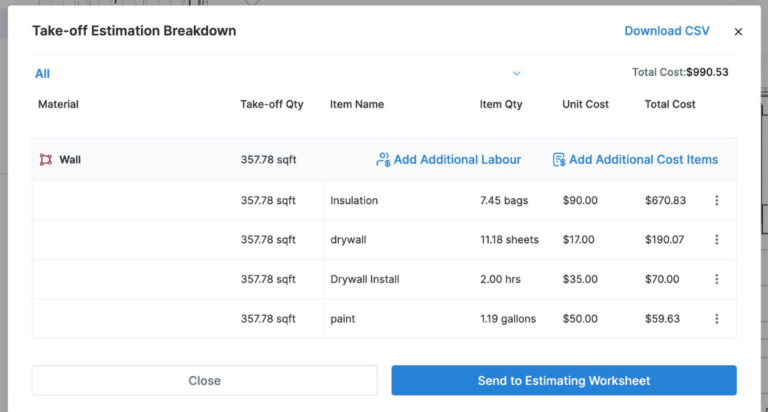

Construction estimating is how contractors turn drawings into a number they can stand behind. It starts with measuring the work. It ends with submitting a price.
Between those steps is a structured process that determines whether a job will be profitable, competitive, and realistic to execute.
This guide walks through the full construction estimating process from takeoff to final bid, and explains how each step connects.
Step 1: Start With a Takeoff
Every estimate begins with a takeoff. A takeoff measures quantities from drawings. It identifies how much material, labour, and work is involved.
If quantities are incomplete, the estimate will be incomplete.
Takeoffs measure the work. Estimating prices it.
For a deeper explanation of how estimating works at a foundational level, read: What Is Construction Estimating?
Step 2: Turn Quantities Into Cost
Once quantities are complete, pricing begins.
This is where contractors apply:
- Material costs
- Labour costs
- Equipment and job expenses
- Overhead
- Profit
Together, these components form the total projected project cost. Estimating is not guesswork. It is structured cost building based on scope and realistic assumptions.
To understand how contractors build pricing in detail, see: How Contractors Build a Construction Estimate
Step 3: Understand the Difference Between Estimate and Bid
Estimating calculates cost. Bidding determines the number submitted to win the job.
A bid may include strategic adjustments based on competition, workload, or risk tolerance. But it should always be grounded in a solid estimate.
Confusing these steps can lead to pricing decisions without full cost visibility.
For a clear breakdown of the differences, read: Takeoff vs Estimate vs Bid
Step 4: Avoid Common Estimating Pitfalls
Even experienced contractors make estimating mistakes.
Common issues include:
- Missing scope
- Unrealistic labour assumptions
- Not updating quantities after revisions
- Underestimating overhead
- Disconnected workflows
These small gaps can significantly impact margins. Understanding where estimates break down is just as important as knowing how to build them.
To explore this further, read: Common Construction Estimating Mistakes
How Construction Estimating Fits Into the Full Workflow
Construction estimating sits between design and execution.
The flow typically looks like this:
- Drawings define scope
- Takeoffs measure quantities
- Estimates calculate cost
- Bids submit pricing
- Construction begins
Each step builds on the one before it.
When the estimating process is clear and structured, contractors can:
- Price more confidently
- Revise faster when drawings change
- Protect margins
- Reduce risk
Estimating is not just a pricing task. It is a financial planning step that affects everything that follows.
Final Thoughts
Construction estimating connects scope to cost and cost to strategy.
Strong quantities lead to strong pricing. Strong pricing leads to confident bids. When each step is handled intentionally, projects begin with clarity instead of uncertainty.
Use this guide as a roadmap, then explore each topic in more depth through the linked articles above.